

Your Privacy Choices

As described in our Privacy Policy, we collect personal information from your interactions with us and our website, including through cookies and similar technologies. We may also share this personal information with third parties, including advertising partners. We do this in order to show you ads on other websites that are more relevant to your interests and for other reasons outlined in our privacy policy.

Sharing of personal information for targeted advertising based on your interaction on different websites may be considered "sales", "sharing", or "targeted advertising" under certain U.S. state privacy laws. Depending on where you live, you may have the right to opt out of these activities. If you would like to exercise this opt-out right, please follow the instructions below.

If you visit our website with the Global Privacy Control opt-out preference signal enabled, depending on where you are, we will treat this as a request to opt-out of activity that may be considered a “sale” or “sharing” of personal information or other uses that may be considered targeted advertising for the device and browser you used to visit our website.

AdvertorialThis article is sponsored content. The following is a paid advertisement for VitalFleaux. Results may vary. This content is not intended as medical advice.

Shift Worker Health 10 min read

7 Reasons Shift Workers Are Switching to Magnesium Glycinate

If you work nights, rotating shifts, or irregular hours — your body is running a magnesium deficit. Here’s what happens when you fix it.

Healthcare professional holding VitalFleaux Magnesium Glycinate
Did you know?
Studies estimate that over 68% of Americans don’t get enough magnesium from diet alone — and shift workers are at significantly higher risk due to chronic sleep disruption, elevated cortisol, and increased urinary magnesium excretion.

Her name was Keisha. Thirteen years as a floor nurse, working rotating shifts that had long since stopped feeling unusual. She’d adapted — or so she thought.

“I thought I was just getting older,” she told us. “I figured this was the price you pay for the schedule. The muscle cramps, the brain fog, the anxiety after night shifts — I assumed it was normal. I’d been living with it so long I forgot what normal actually felt like.”

What Keisha didn’t know — and what most shift workers never find out — is that her schedule was quietly draining a mineral her body desperately needed. Not because she wasn’t eating well. Not because she wasn’t trying hard enough. Because chronic sleep disruption, elevated cortisol, and the physical demands of healthcare work create a magnesium deficit that diet alone cannot fix.

Six weeks after starting magnesium glycinate, Keisha sent us a message: “I feel like myself again. I didn’t realize how depleted I was until I wasn’t anymore.”

Her story isn’t unusual. It’s the story we hear from shift workers every week. And it’s why we wrote this.

🧠
Reason #01

It Quiets a Racing Mind — Even If Sleep Isn’t Your Problem*

The #1 reason shift workers start taking it isn’t insomnia. It’s the inability to switch off.*

You finish a 12-hour shift. You’re exhausted. But the moment you lie down, your brain won’t stop. You’re replaying the night, running through tomorrow’s tasks, or just lying there with a low hum of anxiety that won’t quit. This is one of the most common complaints among shift workers — and it has nothing to do with insomnia in the traditional sense.

Magnesium glycinate works at the neurological level by activating GABA receptors — the brain’s primary “calm down” signal.* When magnesium levels are depleted (which happens rapidly under chronic stress and disrupted sleep schedules), your nervous system loses its ability to downregulate. The result is that wired, can’t-switch-off feeling that follows you home from every shift.

Critically, this benefit applies whether you struggle to sleep or not. Nurses, EMTs, and factory workers who report no sleep issues still describe a meaningful reduction in mental restlessness, background anxiety, and the feeling of being perpetually “on edge” after starting magnesium glycinate consistently. It is not a sedative — it is a nervous system reset.*

💡 Not just for sleep.*
Magnesium glycinate may support daytime calm, stress resilience, and nervous system regulation — regardless of whether you have a sleep disorder.*
★★★★★

“I don’t have insomnia — I just couldn’t turn my brain off after nights. Three weeks in, I noticed I was actually relaxed when I got home. That hadn’t happened in years.”
— Darnell W., ER Technician ✓ Verified Buyer
Reason #02

Why Everything Else You’ve Tried Has Failed

Melatonin. Diphenhydramine sleep aids. Magnesium oxide. Prescription sleep aids. If none of them worked, there’s a reason — and it’s not you.

Melatonin tells your brain it’s nighttime — but it doesn’t fix the underlying nervous system dysregulation that keeps shift workers wired and unable to wind down. It can help you fall asleep faster, but it does nothing for sleep quality, muscle recovery, or the anxiety that follows you home from a 12-hour shift.

Diphenhydramine-based OTC sleep aids work by blocking histamine receptors — essentially sedating you. They are antihistamines being repurposed as sleep aids. They build tolerance within days, cause significant next-day cognitive impairment, and do nothing to address why you’re not sleeping well in the first place.

Magnesium oxide is the form found in most cheap supplements and grocery store brands. Here’s the problem: it has an absorption rate of roughly 4%. The other 96% passes through your digestive system, which is why it’s primarily used as a laxative. If you’ve tried magnesium before and felt nothing, this is almost certainly why.

Magnesium glycinate is different because it addresses the actual root cause: a depleted nervous system that has lost its ability to regulate itself. It’s absorbed at a rate of 80%+ because the glycine molecule escorts it directly into your cells.

💡 The root cause.
Most solutions treat the symptom. Magnesium glycinate addresses the deficiency driving the symptoms — and that’s why it works when everything else hasn’t.
★★★★★

“I’d tried everything. Melatonin made me groggy. Magnesium citrate gave me stomach issues. I almost didn’t try this. Three weeks in and I finally understand what people mean when they say they slept well.”

— Darnell W., ER Technician ✓ Verified Buyer
Reason #03

10 Signs You’re Already Magnesium Deficient (Most Shift Workers Are)

Over 68% of Americans don’t get enough magnesium from diet alone. Shift workers are at significantly higher risk.

Magnesium deficiency is sometimes called the “invisible deficiency” because standard blood tests often miss it — only 1% of the body’s magnesium is in the bloodstream, so serum levels can appear normal even when cellular stores are critically low.

Shift workers are at disproportionate risk for three specific reasons: chronic sleep disruption elevates cortisol, which directly depletes magnesium; increased physical and mental stress accelerates urinary magnesium excretion; and irregular eating patterns make dietary replenishment inconsistent. If you work nights or rotating shifts and experience three or more of the signs below, there is a strong likelihood your magnesium levels are suboptimal.

Check every symptom you experience:
You checked 0 of 10 symptoms
★★★★★

“I had six of these symptoms and had no idea they were connected. I thought it was just the job. Two months in and the leg cramps, the anxiety, the brain fog — all significantly better.”

— Priya M., ICU Nurse ✓ Verified Buyer
🌙
Reason #04

Their Sleep Quality Has Completely Transformed*

Magnesium glycinate doesn’t force sleep. It restores the conditions your brain needs to sleep naturally.*

When you work rotating shifts or overnight, your body’s natural melatonin production gets thrown completely off schedule. You’re trying to sleep when your brain thinks it’s daytime — and the result is shallow, fragmented rest that leaves you exhausted even after 8 hours in bed.

Magnesium glycinate works differently from sleep aids. Rather than sedating you, it activates the GABA receptors in your brain — the same receptors that signal “it’s safe to relax.”* Research suggests that magnesium supplementation may support sleep onset, sleep efficiency, and the amount of time spent in deep, restorative slow-wave sleep.*

Shift workers who start taking magnesium glycinate consistently report falling asleep faster and waking up actually feeling rested — often for the first time in years.*

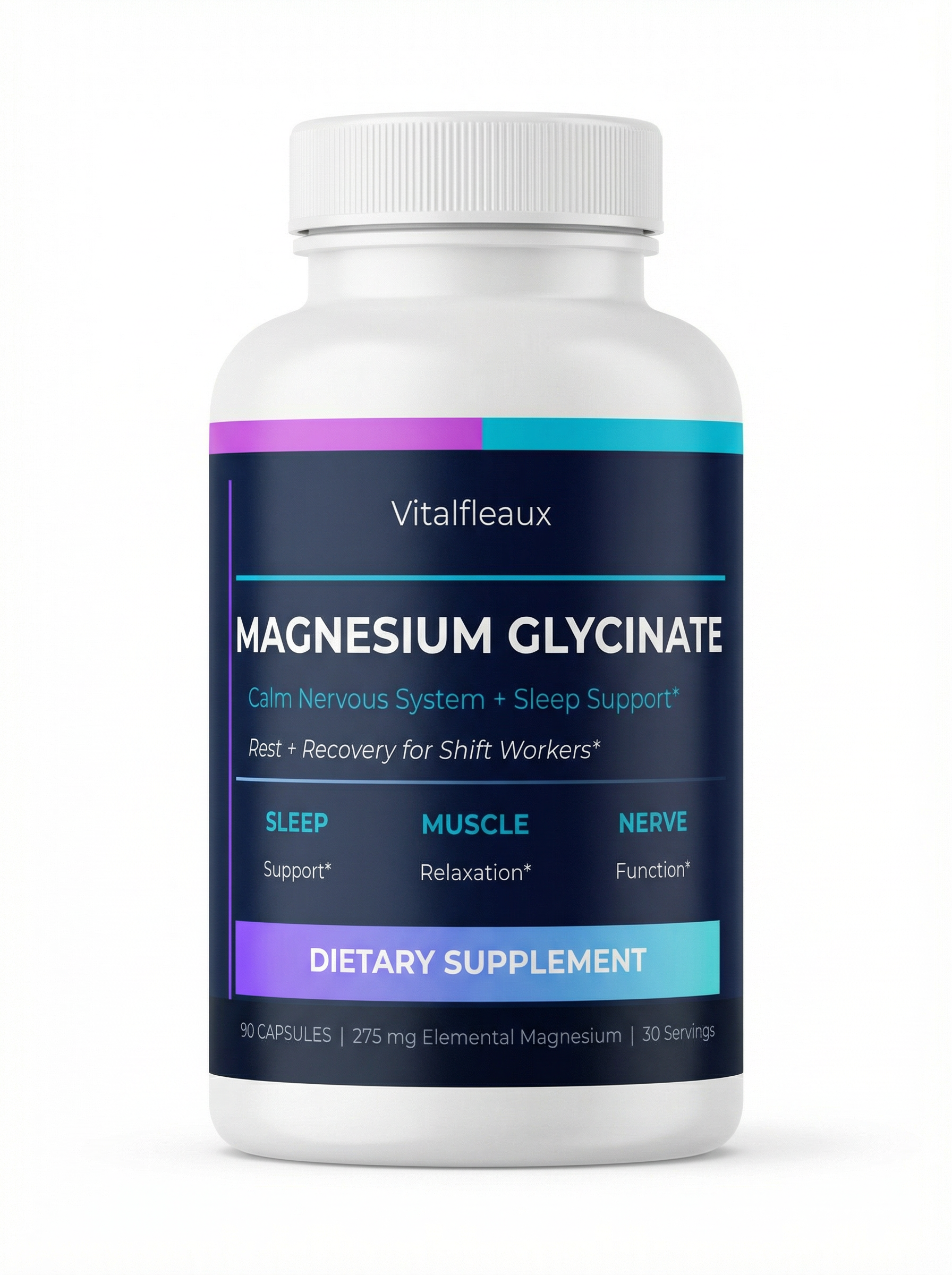
VitalFleaux Magnesium Glycinate
Ready to feel the difference?
Join thousands of shift workers who’ve made the switch.
GET 15% OFF YOUR FIRST ORDER →
Subscribe & Save · Free Shipping · GMP Certified
★★★★★

“I’ve worked nights for 11 years and always struggled to sleep during the day. After 3 weeks on this, I’m out within 20 minutes and actually waking up refreshed.”

— Marcus T., ICU Nurse ✓ Verified Buyer
Reason #05

Is More Better? The Truth About Dosage*

If it’s working, should you double the dose for faster results? Here’s what the science actually says.

The recommended clinical dose for magnesium glycinate is 200–400mg of elemental magnesium per day. VitalFleaux provides 275mg per serving (3 capsules), which sits in the optimal therapeutic range. Taking significantly more than this does not accelerate the benefits — your body can only absorb and utilize a certain amount at a time.

The correct approach is consistency over quantity. Taking the recommended dose every night for 4–8 weeks produces far better results than taking double the dose for two weeks. Magnesium works by replenishing cellular stores over time — it is not an acute supplement like caffeine or melatonin.

💡 The right dose.*
275mg elemental magnesium (3 capsules of VitalFleaux) taken 30–60 minutes before bed is the optimal protocol. Do not exceed 400mg/day without consulting a healthcare provider.
★★★★★

“I tried taking 6 capsules thinking it would work faster. It didn’t — just gave me an upset stomach. Went back to 3 and stayed consistent. By week 5 I was sleeping through my whole sleep window for the first time in years.”

— James R., Paramedic ✓ Verified Buyer
💪
Reason #06

Their Muscle Cramps and Soreness Have Disappeared*

Magnesium is the mineral your muscles need to relax. Without enough of it, they stay in a state of low-level contraction.*

Every time a muscle contracts — every step you take, every time you lift a patient, every hour you spend on your feet — magnesium is required to release that contraction.* When magnesium is depleted, muscles can’t fully relax, leading to the cramps, spasms, and restless legs that shift workers accept as occupational hazards.*

The glycinate form is critical here. Unlike magnesium oxide, magnesium glycinate is bound to the amino acid glycine, which dramatically increases absorption. Your muscles actually receive the magnesium instead of it passing through your digestive system unused. Most shift workers notice a significant reduction in leg cramps and post-shift soreness within the first two weeks of consistent use.*

★★★★★

“My calves used to cramp so badly after long shifts I couldn’t sleep. This has been a complete game changer. Zero cramps in 6 weeks.”

— Priya S., ER Technician ✓ Verified Buyer
🧠
Reason #07

Their Anxiety and Stress Response Has Calmed Down*

Chronic sleep deprivation keeps your nervous system in a constant state of fight-or-flight.*

Working irregular hours doesn’t just affect your sleep — it keeps your cortisol (stress hormone) chronically elevated. You’re running on adrenaline to get through your shift, then unable to wind down when you finally get home. The result is a nervous system that never fully recovers, leading to heightened anxiety, irritability, and emotional exhaustion.

Magnesium plays a central role in regulating the HPA axis — the system that controls your stress response.* It acts as a natural calcium channel blocker in the nervous system, helping to support healthy neurological function.* Low magnesium levels are associated with increased anxiety and a heightened stress response.* Shift workers report that magnesium glycinate helps them feel noticeably calmer during their off-hours.*

★★★★★

“I used to come home from night shifts completely wired and anxious. Now I actually feel calm when I get home. My family has noticed the difference too.”

— Carlos M., Registered Nurse ✓ Verified Buyer

The Bottom Line

Shift work is hard on your body in ways that most supplements don’t address. Magnesium glycinate is one of the few that directly targets the root causes of shift worker fatigue — disrupted sleep architecture, chronic nervous system activation, muscle depletion, and cellular energy production.

It’s not a quick fix. The shift workers who see the most dramatic results are those who take it consistently, every night, for at least 6–8 weeks. That’s when the cumulative effects on sleep quality, recovery, and stress resilience become undeniable.

If you work nights, rotating shifts, or any schedule that disrupts your natural sleep-wake cycle — magnesium glycinate is the single most impactful supplement you can add to your routine.

What to Look for in a Magnesium Glycinate Supplement

High elemental magnesium per serving
Look for at least 200–300mg of elemental magnesium per dose, not just magnesium glycinate weight.
No unnecessary fillers or additives
Avoid supplements with artificial colors, flavors, or proprietary blends that obscure actual dosages.
Third-party tested
Independent testing confirms what’s on the label is actually in the capsule — critical for healthcare workers.
GMP certified manufacturing
Good Manufacturing Practice certification ensures consistent quality and safety standards.
Capsule form over powder
Capsules are more convenient, tasteless, and easier to take consistently before bed.
★★★★★
4.9 out of 5 · 2,847 verified reviews
VitalFleaux Magnesium Glycinate

VitalFleaux Magnesium Glycinate

275mg Elemental Magnesium · 90 Capsules · 30 Servings
Calm Nervous System + Sleep Support* · Rest + Recovery for Shift Workers*
SHOP NOW — SAVE 15% ON FIRST ORDER ›
Subscribe & Save · Free Shipping · GMP Certified · Made in USA
FDA DISCLAIMER
*These statements have not been evaluated by the Food and Drug Administration. This product is not intended to diagnose, treat, cure, or prevent any disease. Individual results may vary. Always consult a qualified healthcare provider before beginning any supplement regimen.
VitalFleaux | 6701 Corporate Dr. Ste N, Johnston, IA 50131