

11 Things That Happen When Shift Workers Finally Fix Their Magnesium

AdvertorialThis article is sponsored content. The following is a paid advertisement for VitalFleaux. Results may vary. This content is not intended as medical advice.

Shift Worker Health 11 min read

11 Things That Happen When Shift Workers Finally Fix Their Magnesium

Your schedule is depleting a mineral your nervous system can’t function without. Here’s what changes — physically, mentally, and emotionally — when you stop running on empty.

Healthcare professional ? shift worker health and recovery
The shift work paradox
Chronic sleep disruption elevates cortisol — and elevated cortisol directly accelerates urinary magnesium excretion. The harder your schedule works your body, the faster it depletes the mineral your body needs to recover from that schedule. Research estimates that over 68% of Americans are already magnesium-insufficient — and shift workers are at significantly higher risk.

His name was Andre. Fourteen years as a paramedic, running 24-on-48-off cycles that had long since stopped feeling unusual. He’d adapted — or so he thought. He had a system: blackout curtains, a fan for white noise, melatonin on the nights he really needed it. He ate well. He worked out when he could. By every measure, he was doing everything right.

But he was exhausted in a way that sleep didn’t fix. He’d wake up after seven hours feeling like he hadn’t slept at all. His legs cramped constantly. He was short-tempered with his kids on his days off — not because he wanted to be, but because he couldn’t seem to fully decompress.

“I thought it was just the job,” he told us. “I thought everyone felt this way. I thought this was what fourteen years of shift work did to you and there was nothing to do about it.”

What Andre didn’t know — and what most shift workers never find out — is that his schedule had been quietly creating a magnesium deficit that his body couldn’t compensate for through diet alone. Chronic cortisol elevation, the hallmark of shift work physiology, directly accelerates magnesium excretion. The more demanding his schedule, the faster his stores depleted.

Eight weeks after starting magnesium glycinate, Andre sent us a message: “I feel like I got my life back. I didn’t realize how much I’d been running on fumes until I wasn’t anymore.”

His story is not unusual. We hear versions of it from shift workers every week. And it’s why we put together this list.

🧠
#01

Your Nervous System Is Stuck in Overdrive — And It’s Not Your Fault*

Shift work doesn’t just disrupt your sleep. It keeps your stress system permanently activated — and that’s the root of everything else.*

There’s a mechanism at work in your body that most healthcare providers never explain to shift workers. It’s called HPA axis dysregulation — and it’s the reason you can finish a 12-hour shift completely exhausted, lie down, and still feel like your brain is running at full speed.

The HPA axis is your body’s stress command center. Under normal circumstances, cortisol rises in the morning, peaks around noon, and tapers off by evening. When you work rotating shifts or overnights, this rhythm gets completely inverted. Your cortisol spikes when it should be falling, and your nervous system never gets the signal that it’s safe to stand down.

Magnesium is the mineral that directly regulates this system.* It acts as a natural brake on cortisol production and activates the GABA receptors that tell your nervous system to downregulate.* When magnesium levels are depleted, your HPA axis loses its governor. The result is that perpetual, low-grade state of activation that shift workers know as their baseline.*

💡 The real mechanism.*
Magnesium glycinate may support healthy cortisol regulation and GABA receptor activity — directly addressing the nervous system dysregulation that drives shift worker fatigue.*
★★★★★

“I didn’t realize how tense I was all the time until I wasn’t anymore. It took about three weeks but I started noticing I could actually relax when I got home. That hadn’t happened in years.”
— Renata V., Emergency Room Nurse ✓ Verified Buyer
#02

Why Every Other Solution Has Let You Down

Melatonin. OTC sleep aids. Cheap magnesium. Prescription options. Each one targets a symptom while the root cause keeps draining you.

Melatonin is a timing signal — it tells your brain it’s nighttime. But it does nothing to address the cortisol elevation, nervous system activation, or cellular depletion that keeps shift workers wired and exhausted simultaneously. At higher doses, it often causes next-day grogginess that compounds the problem.

Diphenhydramine-based OTC sleep aids work by blocking histamine receptors, essentially sedating you. Tolerance builds within three to five days, next-day cognitive impairment is significant and well-documented, and they do nothing to address the physiological reasons you can’t sleep in the first place.

Cheap magnesium supplements — almost universally the oxide form — have an absorption rate of approximately 4%. The remaining 96% passes through your digestive system without entering your cells, which is why magnesium oxide is primarily used as a laxative. If you’ve tried magnesium before and felt nothing, this is almost certainly why.

Magnesium glycinate is different because it targets the actual root: a depleted, dysregulated nervous system. The glycine molecule escorts magnesium directly into your cells at an absorption rate exceeding 80%. It doesn’t sedate you — it restores the biochemical conditions your body needs to regulate itself.

💡 Absorption is everything.
Magnesium glycinate absorbs at 80%+. Magnesium oxide absorbs at roughly 4%. The form matters as much as the dose.
★★★★★

“I’d been taking cheap magnesium for two years and felt nothing. Switched to glycinate and noticed a difference within ten days. I wish someone had told me about the absorption difference sooner.”

— Tyrone B., Factory Night Shift Supervisor ✓ Verified Buyer
#03

10 Signs Your Body Is Running Low (Most Shift Workers Have at Least 5)

Standard blood tests miss magnesium deficiency 95% of the time. The real indicators show up in how you feel every day.

Only 1% of the body’s magnesium is in the bloodstream — which means serum magnesium tests are almost useless for detecting deficiency. Your levels can appear perfectly normal on a lab report while your cells are critically depleted. Doctors rarely test intracellular magnesium, and most shift workers never get tested at all.

The practical way to assess your magnesium status is through symptoms. Shift workers are at disproportionate risk for deficiency because chronic sleep disruption elevates cortisol, which directly increases urinary magnesium excretion. Check every sign below that you experience regularly:

Check every symptom you experience regularly:
You checked 0 of 10 symptoms
★★★★★

“I had seven of these and had no idea they were connected. I thought it was just the job. Six weeks in, the leg cramps are gone, the anxiety is way down, and I’m actually sleeping.”

— Priya M., ICU Nurse ✓ Verified Buyer
🌙
#04

Deep, Restorative Sleep — Even When Your Schedule Says Otherwise*

Magnesium glycinate doesn’t knock you out. It rebuilds the neurological conditions for natural, high-quality sleep.*

Shift workers don’t just have trouble falling asleep — they have trouble reaching and maintaining deep sleep. Slow-wave sleep (the stage where growth hormone is released, tissue repairs, and memory consolidates) requires a calm, low-cortisol neurological environment. When you’re chronically stressed and magnesium-depleted, your brain can’t get there even when you’re technically asleep.

Research suggests that magnesium supplementation may support sleep efficiency, reduce the time it takes to fall asleep, and increase the proportion of time spent in deep slow-wave sleep.* The glycine component of magnesium glycinate has independent sleep-supporting properties as well — it may help lower core body temperature, which is a key signal for deep sleep onset.*

Shift workers who supplement consistently report a qualitative change in their sleep — not just longer, but genuinely restorative. The difference between sleeping and actually recovering.*

★★★★★

“I’ve worked nights for nine years and accepted that I’d always feel tired. After five weeks on this, I woke up one morning and realized I actually felt rested. I didn’t know what to do with that feeling.”

— Marcus T., ICU Nurse ✓ Verified Buyer
#05

How Much to Take — And When the Results Actually Start*

The research is clear on dosage. Most people take too little, too inconsistently, and give up before the cumulative effects kick in.

Magnesium glycinate is not an acute supplement — it doesn’t work like caffeine or melatonin where you feel something within an hour. It works by replenishing cellular magnesium stores that have been depleted over months or years. That process takes time, and the timeline is predictable.

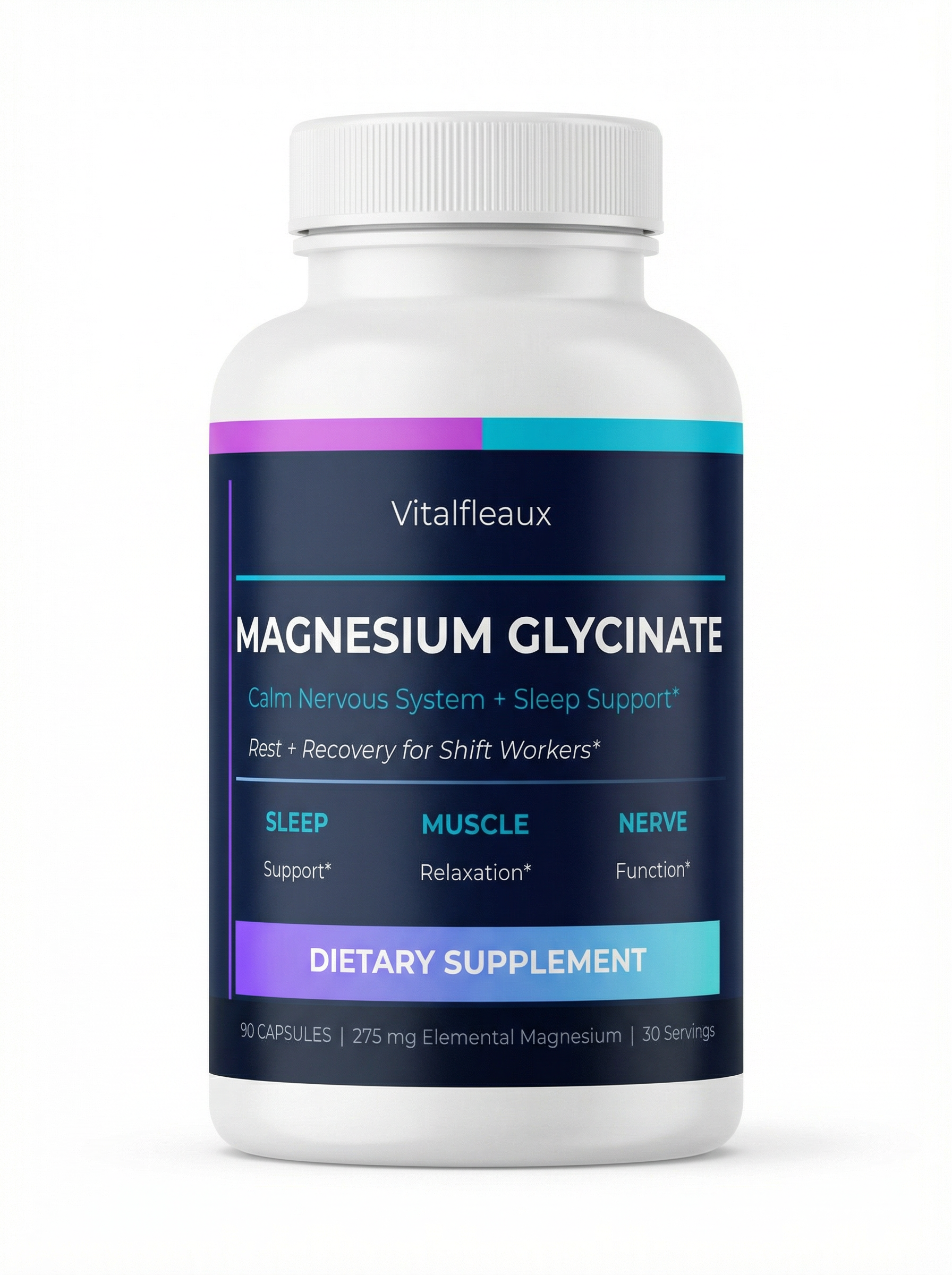
The clinically supported dose is 200–400mg of elemental magnesium per day. VitalFleaux provides 275mg per serving (3 capsules), which sits in the optimal therapeutic range. This should be taken 30–60 minutes before bed, consistently, every night.

Most shift workers notice the first effects within 7–14 days: reduced muscle cramping, slightly easier sleep onset, and a mild reduction in post-shift anxiety. The more significant changes typically emerge at 4–6 weeks. The full cumulative benefit is usually apparent at 8–12 weeks of consistent use.

💡 The protocol.*
275mg elemental magnesium (3 capsules) taken 30–60 minutes before bed, every night, for a minimum of 6–8 weeks. Consistency is the variable that determines results.
VitalFleaux Magnesium Glycinate
Ready to break the cycle?
Join thousands of shift workers who’ve finally addressed the root cause.
GET 15% OFF YOUR FIRST ORDER →
Subscribe & Save · Free Shipping · GMP Certified
★★★★★

“I almost quit after two weeks because I didn’t notice much. My partner convinced me to stick with it. By week six I was a completely different person. Wish I’d known to expect a longer timeline.”

— James R., Paramedic ✓ Verified Buyer
💪
#06

The Muscle Cramps, Twitches, and Soreness Stop*

Every muscle contraction in your body requires magnesium to release. Without enough, your muscles stay partially contracted — all the time.*

This is one of the most immediate and concrete benefits shift workers report, and the mechanism is straightforward. Muscle contraction is triggered by calcium. Muscle relaxation requires magnesium to displace that calcium and allow the fiber to release.* When magnesium is depleted, muscles can’t fully relax — leading to the cramps, spasms, restless legs, and persistent soreness that shift workers accept as occupational hazards.*

The glycinate form is critical here because your muscles can only use the magnesium that actually reaches your cells. Magnesium oxide has roughly 4% absorption — your muscles receive almost none of it. Magnesium glycinate delivers 80%+ into your cells, which is why the reduction in cramping and soreness is typically noticeable within the first two weeks.*

★★★★★

“My calves used to cramp so badly after long shifts I couldn’t sleep even when I was exhausted. Zero cramps in six weeks. I didn’t realize how much that was affecting my sleep until it stopped.”

— Priya S., ER Technician ✓ Verified Buyer
💓
#07

The Background Anxiety Quiets Down*

Shift work anxiety isn’t a personality trait. It’s a physiological state — and it responds to magnesium.*

There’s a specific kind of anxiety that shift workers describe: not panic attacks, not clinical anxiety disorder, but a persistent, low-grade hum of tension that never fully goes away. You go home and you can’t fully relax. You’re off for three days and you still feel like you’re at work.

Magnesium acts as a natural regulator of the NMDA receptor, which is involved in stress and anxiety signaling.* Low magnesium levels are associated with heightened stress reactivity and increased anxiety.* Supplementation may support a calmer, more regulated baseline — not sedation, but a genuine reduction in background tension.*

★★★★★

“My husband noticed before I did. He said I seemed calmer. I realized he was right — I wasn’t snapping at small things anymore. I was actually present when I was home.”

— Carlos M., Registered Nurse ✓ Verified Buyer
#08

Stable Energy — Without the Crashes*

Magnesium is required for ATP production. Without it, your cells can’t generate energy efficiently — no matter how much you sleep.*

ATP is the molecule your cells use for energy. Every cell in your body — your muscles, your brain, your heart — runs on it. And magnesium is required for ATP to be biochemically active.* Without adequate magnesium, your mitochondria cannot efficiently convert nutrients into usable energy, regardless of how much you eat or sleep.*

Supplementing with magnesium glycinate doesn’t create a stimulant effect. It restores your baseline. Shift workers describe it as their battery finally charging properly — not a spike in energy, but a steadiness that wasn’t there before.*

★★★★★

“I stopped needing three coffees just to function. My energy is steadier through the whole shift and I don’t crash as hard when I get home.”

— Danielle K., Floor Nurse ✓ Verified Buyer
🕐
#09

Faster Recovery Between Shifts*

Recovery isn’t about how many hours you sleep. It’s about what your body does during those hours.*

The difference between sleeping and recovering is what happens during deep slow-wave sleep. Growth hormone release, tissue repair, immune function, and metabolic restoration all occur primarily during this stage. If you’re not reaching it consistently — which shift workers almost never do without intervention — your body never fully recovers between shifts, regardless of how many hours you spend in bed.

Magnesium glycinate may support the depth and quality of sleep, not just its duration.* The glycine component independently supports core body temperature reduction, which is a key physiological trigger for deep sleep onset.* Shift workers who supplement consistently report being meaningfully more functional going into their third or fourth consecutive shift.*

★★★★★

“I work three 12-hour shifts back to back every week. I used to be barely functional by the third day. Now I go into that third shift feeling like a person.”

— James R., Paramedic ✓ Verified Buyer
🛡
#10

You’re Protecting Your Long-Term Health — Not Just Managing Today*

Shift work is one of the most well-documented occupational health risks. Magnesium is one of the few evidence-supported ways to support your body against it.*

The long-term health data on shift work is sobering. Decades of research consistently show elevated rates of cardiovascular disease, type 2 diabetes, metabolic syndrome, and immune dysfunction among chronic shift workers — driven primarily by circadian disruption, chronic cortisol elevation, and the systemic inflammation that results.

Magnesium plays a supportive role across multiple systems implicated in these outcomes.* It may support healthy blood pressure, healthy blood sugar metabolism, and inflammatory balance.* For shift workers, this isn’t a theoretical benefit — it’s a direct counterweight to the specific physiological stresses your schedule creates.*

★★★★★

“My doctor mentioned my blood pressure was trending up. I started taking this and made a few other changes. It’s been part of getting things back in range. I wish I’d started years ago.”

— Tasha W., Hospital Administrator ✓ Verified Buyer
#11

It Works With Your Body — Not Against It*

No dependency. No tolerance. No next-day impairment. Just your nervous system doing what it was designed to do.*

This is what separates magnesium glycinate from every other sleep and recovery solution on the market: it doesn’t override your body’s systems, it restores them.* Melatonin manipulates your sleep timing signal. OTC antihistamine sleep aids sedate you by blocking histamine. Prescription options carry dependency and rebound risks. All of them work by overriding a system rather than supporting it.

Magnesium glycinate works by replenishing a mineral your body already uses — and already needs — for hundreds of biochemical processes. You cannot build tolerance to it because it’s not a drug; it’s a nutrient. You don’t experience rebound insomnia when you stop because it’s not suppressing anything.*

The shift workers who get the most out of it are those who treat it as a foundational protocol rather than a quick fix. Consistent nightly use for 8–12 weeks produces results that compound over time.*

★★★★★

“I’ve been taking it for four months now. It’s just part of my routine. I don’t think about it as a sleep supplement anymore — I think of it as maintenance. My body works better when I take it.”

— Sarah L., Night Shift Security Supervisor ✓ Verified Buyer

The Bottom Line

Shift work creates a specific, well-documented physiological burden: chronic cortisol elevation, circadian disruption, cellular energy depletion, and the progressive accumulation of a magnesium deficit that standard blood tests almost never catch. Most solutions address the symptoms of this burden without touching the root.

Magnesium glycinate is different because it directly replenishes the mineral your nervous system needs to regulate itself. Not as a sedative. Not as a stimulant. As a foundational nutrient that your schedule is actively depleting — and that your body cannot function optimally without.

The shift workers who see the most meaningful results are those who treat it as a protocol, not a trial. Eight to twelve weeks of consistent nightly use, at the correct dose, is where the cumulative effects become undeniable.

What to Look for in a Magnesium Glycinate Supplement

Magnesium glycinate — not oxide, citrate, or ‘magnesium blend’
The form determines absorption. Glycinate absorbs at 80%+. Oxide absorbs at roughly 4%. Always check the form on the label.
200–300mg elemental magnesium per serving
This is the amount of actual magnesium delivered, not the weight of the magnesium glycinate compound. Look for ‘elemental magnesium’ on the label.
Third-party tested for purity and potency
Independent testing confirms what’s on the label is actually in the capsule — critical for anyone in healthcare or safety-sensitive work.
GMP certified manufacturing
Good Manufacturing Practice certification ensures consistent quality, accurate dosing, and safety standards across every batch.
No unnecessary fillers, artificial colors, or proprietary blends
Proprietary blends obscure actual dosages. Clean labels with transparent ingredient amounts are the standard to hold supplements to.
★★★★★
4.9 out of 5 · 2,847 verified reviews
VitalFleaux Magnesium Glycinate

VitalFleaux Magnesium Glycinate

275mg Elemental Magnesium · 90 Capsules · 30 Servings
Calm Nervous System + Sleep Support* · Rest + Recovery for Shift Workers*
SHOP NOW — SAVE 15% ON FIRST ORDER ›
Subscribe & Save · Free Shipping · GMP Certified · Made in USA
FDA DISCLAIMER
*These statements have not been evaluated by the Food and Drug Administration. This product is not intended to diagnose, treat, cure, or prevent any disease. Individual results may vary. Always consult a qualified healthcare provider before beginning any supplement regimen.
VitalFleaux | 6701 Corporate Dr. Ste N, Johnston, IA 50131